German Citizenship for Expats: 2026 Guide
German citizenship for expats in 2026: 5 years of residence, dual citizenship allowed, B1 German, a 17/33 test, €255 fee and how to apply.
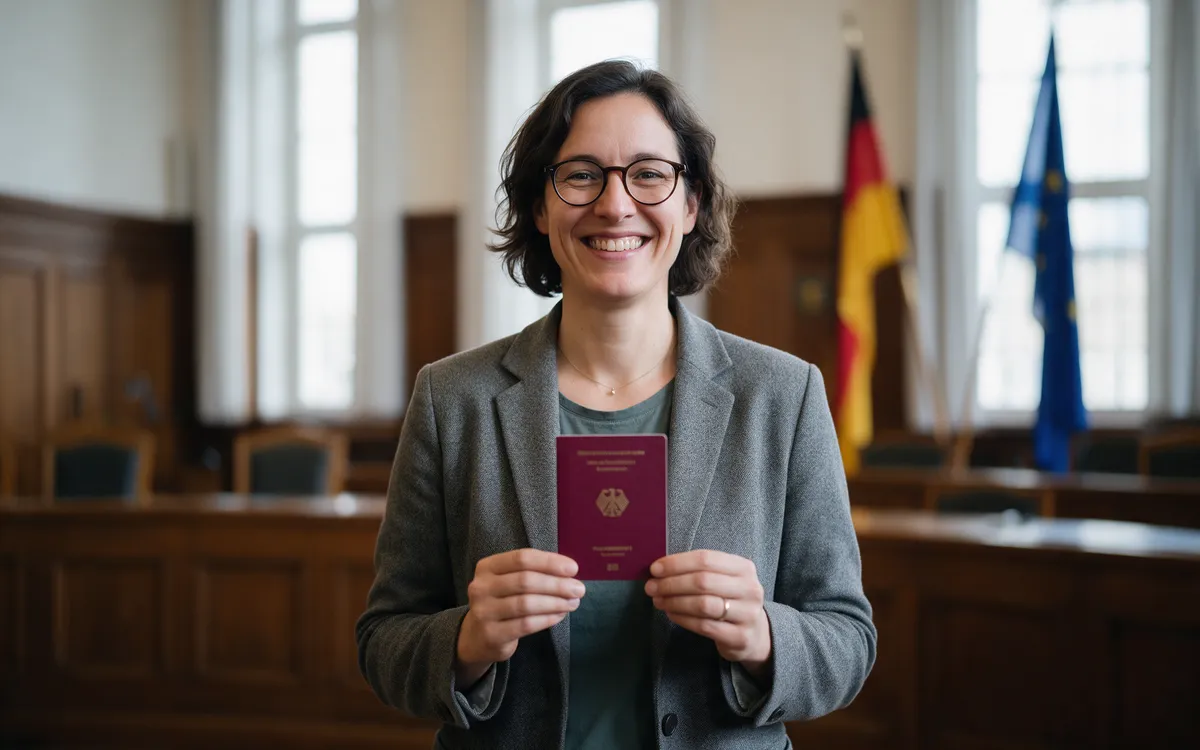
German citizenship for expats is possible after five years of lawful residence in Germany, and since June 2024 you can usually keep your previous nationality. This guide covers naturalisation as it stands in October 2026: the rules after the 2024 reform, the October 2025 change that abolished the three-year fast track, the language level, the naturalisation test, money requirements, fees, the application in Berlin and Munich, and citizenship for children. Everything is written from the statute and official sources listed at the end.
Not there yet? The visa guide shows which residence permit leads to settlement, and the EU Blue Card guide covers a permit with a short route to permanent residence.
Quick answer: can I become a German citizen?
You probably can, once all of these are true:
- You have lived in Germany lawfully with your habitual residence for five years (or three years if you are married to a German, see below).
- You hold a permanent right of residence or one of the residence permits the law lists as qualifying.
- Your identity and nationality are clarified, usually with a valid passport.
- You speak German at level B1 and can show knowledge of the German legal and social order.
- You can support yourself and your dependants without Bürgergeld or social assistance, unless an exception applies.
- You have no criminal conviction that bars you, and you commit to the free democratic basic order and to Germany's historical responsibility.
It is an entitlement: if you meet every condition, the authority must naturalise you on application.
What changed in 2024 and 2025
| Topic | Before 27 June 2024 | Since the 2024 reform | Since 30 October 2025 |
|---|---|---|---|
| Standard residence period | Eight years | Five years | Five years |
| Shortened route | No three-year route | Three years with particularly good integration and C1 German | Abolished. Section 10(3) StAG was deleted |
| Previous nationality | Generally had to be given up, with exceptions | Can be kept: multiple citizenship generally allowed | Unchanged |
| Child born in Germany | Stricter parental conditions | One parent with five years of lawful residence and an unlimited right of residence | Unchanged |
Was the three-year fast track really abolished? Yes. The Bundestag voted on 8 October 2025, and the amending act was published as BGBl. 2025 I Nr. 256. In the current text of Section 10 StAG, paragraph 3 is marked as repealed. The Federal Government's 2024 announcement still describes the three-year route, because it was written before the change. If a website promises citizenship after three years of "special integration", it is out of date.
The three-year period that still exists is the one for spouses and registered partners of German citizens, which is a separate rule (Section 9 StAG). Discretionary naturalisation under Section 8 StAG also remains available in individual cases, but it is a decision by the authority and not an entitlement.
Requirements for German naturalisation
Section 10 of the Citizenship Act (StAG) sets the conditions for the standard route. In plain terms:
- Lawful residence for five years with your habitual residence in Germany. Spouses or registered partners and minor children can be naturalised together with you, even if they have not lived here for five years.
- A qualifying residence status. You need a permanent right of residence or one of the residence permits named in the law, and the EU Blue Card is among the permits mentioned there. The authority checks your exact permit.
- Commitment to the free democratic basic order and a declaration that you have not pursued or supported anti-constitutional efforts. Since the 2024 reform you also commit to Germany's responsibility for the Nazi regime and its consequences, including protecting Jewish life. Antisemitic, racist or otherwise dehumanising acts are incompatible with naturalisation.
- Financial self-sufficiency (details below).
- No relevant criminal conviction. The authority checks your record, so ask the office how a past conviction would be treated if you have one.
- German at B1 and knowledge of the legal and social order, shown through the test or a qualifying school or degree.
- Clarified identity and nationality. A valid passport or ID card is part of every application.
Years of residence by route
| Route | Residence needed | Notes |
|---|---|---|
| General entitlement (Section 10) | 5 years | The standard route for most applicants |
| Spouse or registered partner of a German (Section 9) | 3 years of residence, with the marriage or partnership lasting 2 years | The residence period can be shortened in the public interest if the marriage has lasted three years. The same language and test rules apply |
| Discretionary naturalisation (Section 8) | Lawful habitual residence, no fixed number | Requires your own accommodation, support for yourself and dependants, a clean record and clarified identity; the authority decides |
Your years of residence rest on lawful residence, so keep your permits continuous and register your address with Anmeldung. If you are on a work permit, the Blue Card leads to permanent residence in 27 months (21 with B1), which is a different goal from citizenship but a useful intermediate step.
Dual citizenship in Germany
Since 27 June 2024, Germany generally allows multiple citizenship. Applicants no longer have to renounce their previous nationality. Three practical points:
- Your home country decides its own side. Some countries do not accept a second citizenship and may withdraw yours. Ask the embassy before applying.
- A release has a cost. If your home country requires a formal release, Berlin's portal notes that this costs extra and tells you to check with your consulate.
- You become German in full. That brings the rights and duties of a German citizen, including tax obligations you should review in our taxes guide.
German language level for citizenship
The law sets level B1 of the Common European Framework as sufficient. Berlin accepts proof of at least B1, or a school, vocational training or university credential that shows it. Special rules:
- Children under 16 need age-appropriate language development, not B1.
- Former guest workers and their spouses need only oral everyday German, and the Federal Government says they no longer have to pass the naturalisation test.
- Hardship. If, despite serious and sustained effort, learning German is impossible or lastingly and substantially difficult, the requirement can be limited to everyday spoken German. Illness, disability or age can also waive it.
If you are below B1, our learning German guide compares ways to get there.
The naturalisation test (Einbürgerungstest)
Section 10(5) StAG says your knowledge of the legal and social order is normally proven by passing the naturalisation test. The format is fixed by the naturalisation test ordinance:
| Feature | Detail |
|---|---|
| Questions | 33 multiple-choice questions, four answer options each |
| Pass mark | At least 17 correct |
| Time limit | 60 minutes, under supervision |
| Question pool | 310 published questions: 300 general and 10 for each federal state (three state questions appear in your test) |
| Where | Test centres approved by BAMF, or a test run by the state itself |
| Fee to BAMF | €25 flat fee per participant under the ordinance. Test centres may set their own prices, so ask |
| Proof | A certificate, which stays valid if you move |
Leben in Deutschland test vs the naturalisation test
The Leben in Deutschland test is the final test of the orientation course, which is part of the integration course. The Integration Course Ordinance says this test can also prove the knowledge needed for naturalisation, and Berlin's document list accepts either the Leben in Deutschland certificate or the naturalisation test certificate. Before you book, ask your authority which certificate it accepts and with what result, because the naturalisation test needs 17 correct answers and you should confirm that your certificate meets that standard.
Financial self-sufficiency rules
You must be able to support yourself and your dependants without benefits under SGB II (Bürgergeld) or SGB XII (social assistance). The statute makes three exceptions, which the authority checks case by case:
- Certain early guest workers, whose receipt of benefits is not their fault.
- People who have worked full time for at least 20 of the last 24 months.
- Spouses or partners who live with a person in that second group and a minor child.
There is no fixed income amount in the law. Your authority looks at your actual situation, and Berlin's document list depends on how you earn:
- Employed: contract, six months of salary statements and an employer confirmation. Our net salary calculator guide helps you read your payslip.
- Self-employed: tax assessment, audited report form, tax clearance certificate and business registration. See our tax return guide for the paperwork this builds on.
- Not employed: unemployment, pension or benefit notices, or proof of assets.
Authorities also ask about other benefits you receive, such as Elterngeld, Kindergeld or Wohngeld. Our sick pay guide explains what income you keep if you fall ill, which matters for steady earnings. If you are close to retirement, read our pension guide to understand your future income.
Fees for German citizenship
| Item | Amount |
|---|---|
| Naturalisation, adult | €255 |
| Minor child naturalised together with a parent (no income of its own) | €51 |
| Naturalisation test fee to BAMF | €25 flat fee per participant, plus any test centre charge |
| Release from your previous nationality | Set by your home country |
| Withdrawn or rejected application | Berlin states the fee is halved if you withdraw after substantive processing began; a rejected application still costs the full fee |
Section 38 of the Citizenship Act sets the €255 and €51 amounts, and the Munich and Berlin city pages state the same figures. Online applications in Berlin are paid before submitting.
Documents you will need
- Valid passport or ID card, and your residence permit if you are not an EU citizen
- Registration certificate (Meldebestätigung) from your Anmeldung
- Birth register extract if you were born in Germany; civil status documents such as marriage or divorce certificates where relevant
- Proof of income suited to your situation (see above) and your rental contract with the current rent
- Proof of health and long-term care insurance
- Proof of German at B1 or a qualifying certificate
- Naturalisation test certificate, Leben in Deutschland certificate or a qualifying school or degree
- For children with joint custody, the other custodial parent's signed consent (Berlin)
Every authority adds its own requests. Use the city's quick check before you gather everything.
How to apply: Berlin and Munich
Naturalisation is handled by a local authority, and in both big cities you apply online.
Berlin
Since 1 January 2024, the Landesamt für Einwanderung (LEA) handles citizenship for all of Berlin, replacing the district offices. You run the free quick check, then fill in the online application on service.berlin.de. The form can be saved and finished later, and you pay the fee by credit card or PayPal before submitting. Children under 16 can be included in a custodial parent's application, while spouses, partners and children aged 16 and over apply themselves. Moving there? See our Berlin guide.
Munich
The city's Servicestelle für Zuwanderung und Einbürgerung (SZE) takes applications online after an online quick check. You need a BundID or BayernID account, and a username and password is enough: you do not need the online ID function of your ID card. You upload your ID, residence permit, proof of income, language and civic knowledge. See our Munich guide for the wider setup.
Tip: You apply to the authority responsible for your main residence. If you plan to move during the process, ask your authority what that means for your file.
Processing times
There is no national average, and anything you read as one is a guess. What the authorities say themselves:
- Munich: the city's own service page says the processing time is 18 months and longer.
- Berlin: the LEA took over about 40,000 pending cases on 1 January 2024, expects longer processing times, and asks applicants not to send status enquiries.
- Other cities and towns: they vary. Ask your authority directly, and submit a complete file.
Children and citizenship by birth
Born in Germany to foreign parents
Under Section 4(3) StAG, a child born in Germany becomes German at birth if one parent has lived lawfully and habitually in Germany for five years and holds an unlimited right of residence. The birth register records the acquisition, so nothing needs to be applied for separately. If the parents do not meet the conditions, the child does not receive citizenship automatically, but can be naturalised with a parent later.
Born to a German parent
A child of a German parent is normally German. If the German parent was born abroad after 31 December 1999 and lives abroad, citizenship does not pass on automatically unless the child would otherwise be stateless or the birth is registered with the German authorities within one year.
Naturalised together with a parent
Minor children can be naturalised with a parent without five years of their own residence. The fee is €51 for a child without income of its own. Children need age-appropriate German, and those without legal capacity for the procedure (under 16) do not have to meet the commitment and knowledge requirements themselves.
Your German passport and ID card afterwards
After the naturalisation certificate (Einbürgerungsurkunde) is handed over, you are German. Next steps:
- Apply for a German passport and ID card at your local citizens' office (Bürgeramt) with the certificate. An ID card costs €46 for people aged 24 and over and €27.60 for under 24s, according to the ordinance on ID card fees. Check the current passport fee with your office.
- Update your records. Tell your bank, employer and tax office, and review your bank account and your tax status in our tax guide.
- Deal with your old nationality. If you keep it, follow your home country's rules for renewing its passport.
- No more residence permits. As a German citizen you no longer need a residence permit or immigration office appointments.
Health insurance and citizenship
Authorities ask for proof of health and long-term care insurance with your application, so your cover must be in order. Employees are normally in the public system, and the long-term care insurance guide explains the care side. Children can often be covered through family insurance, depending on the parents' status. Our health insurance overview shows how to choose between public and private health insurance, and the expat insurance guide covers cover for newcomers.
If you are unsure what suits your family, independent consultants such as MyHealthcareBroker compare the market in English, free of charge for you.
FAQ
Was the three-year fast track to German citizenship abolished?
Can I keep my old passport when I become German?
What language level do I need for German citizenship?
How many questions do I need to pass the Einbürgerungstest?
How long does the naturalisation process take?
Will my child be German if it is born in Germany?
Do I need health insurance to become a German citizen?
Sources
Checked on 16 October 2026. Rules and fees can change, and your local authority decides your case.
- Naturalisation requirements, language, test, self-sufficiency: §10 StAG; spouses of Germans: §9 StAG; discretionary naturalisation: §8 StAG
- Citizenship by birth: §4 StAG
- Fees of €255 and €51: §38 StAG
- Repeal of the three-year route (BGBl. 2025 I Nr. 256): Gesetz zur Änderung des Staatsangehörigkeitsgesetzes sowie weiterer Vorschriften
- 2024 reform, five years, dual citizenship, children: Bundesregierung, Modernisierung des Staatsangehörigkeitsrechts
- Test format and fee: Einbürgerungstestverordnung; Leben in Deutschland test as proof: §17 IntV
- Berlin process, fees, documents, processing: service.berlin.de, Einbürgerung beantragen
- Munich process, fees, processing time: Landeshauptstadt München, Einbürgerungsbehörde
- ID card fees: §1 PAuswGebV
Still not sure which insurance fits you?
Independent, English-speaking consultants compare the whole market for you. Free, no commitment, honest about when not to switch.