Electricity and Gas Contracts in Germany
Electricity and gas contracts in Germany explained: how to register Strom when you move in, Grundversorgung vs switching, bills and notice periods.
Electricity and gas contracts in Germany work differently from many other countries: the flat does not come with a supplier. You choose one, you sign a contract in your own name, and if you do nothing, the local default supplier bills you at its standard rates. This guide explains how to register electricity when you move in (Strom anmelden), what separates a basic-supply tariff from a special contract, how advance payments and annual bills work, and how to cancel or switch. It also covers smart meters, green tariffs and what your rent already includes. It describes the rules neutrally and does not recommend a provider.
Quick answer: electricity and gas contracts in Germany
In short: When you move in, note the meter numbers and readings, then sign an electricity contract (and a gas contract if your flat has its own gas supply) for your move-in date. If you do nothing, the local basic supplier (Grundversorger) supplies you from the first kilowatt-hour. Basic supply can be ended with two weeks' notice, so it works as a bridge while you compare tariffs. Special contracts are often cheaper than basic supply but can bind you for up to 24 months. Your own household electricity is not part of the Nebenkosten, so plan for a separate monthly advance payment (Abschlag).
Grundversorgung vs special contract (Sondervertrag)
Every household in Germany falls into one of two types of contract. The basic supplier in your grid area is the company that serves the most household customers there. It is determined every three years by the grid operator, and it must supply every household customer on its published terms and prices (§36 EnWG). Often this is the local Stadtwerke, but not always.
| Grundversorgung (basic supply) | Sondervertrag (special contract) | |
|---|---|---|
| How it starts | Automatically, when you use power without another contract | You sign a tariff with a supplier |
| Prices | General published prices, which the Verbraucherzentrale describes as high | Often cheaper than basic supply, with prices depending on tariff and usage |
| Notice period | Two weeks, at any time (§20 StromGVV) | Set in the contract, with an initial term of up to 24 months |
| Price rise | Supplier must inform you in advance, and you may leave without notice | Same: you may leave without notice if the supplier raises the price |
| Who offers it | Only the basic supplier of your grid area | Any supplier, including the basic supplier |
The Verbraucherzentrale states that almost one in four electricity households and about one in six gas households are in basic supply, so it is worth checking which contract you are on.
What is Ersatzversorgung?
Ersatzversorgung (replacement supply) applies when you draw energy without a contract and it is unclear who supplies you, for example after a supplier goes bankrupt. It lasts for up to three months, and the replacement prices can be higher than the standard basic-supply prices (§38 EnWG). After that you are moved into basic supply unless you sign something else. Do not wait for it to happen: sign a contract for a fixed date.
How to register electricity when you move in (Strom anmelden)
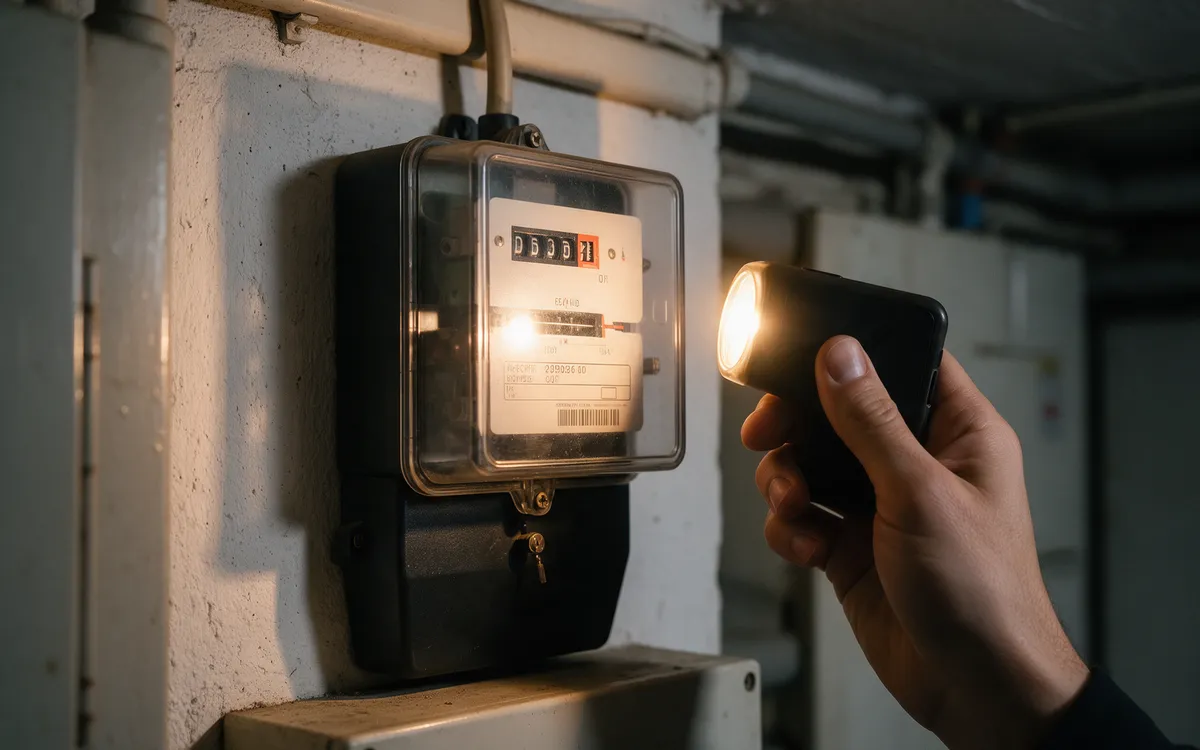
- Find your meters. On the move-in day, photograph the electricity meter (and the gas meter if you have one) and write down the Zählernummer (meter number) and the Zählerstand (reading). Meters are often in the basement, hallway or a shared utility room, so ask your landlord if you cannot find them.
- Check the meter number twice. The Verbraucherzentrale warns that you should be especially careful to enter the right meter number. If you enter a neighbour's number, you only contract for that flat, and your own flat falls into basic supply.
- Choose a start date. Use your move-in date as the start of supply. Many people register a few weeks in advance. A new supplier must confirm in text form whether and from which date it can begin supplying (§20a EnWG).
- Prepare your data. Name, new address, date of birth, expected annual use, bank details for a SEPA direct debit (see the bank account guide), and the meter details. Some suppliers may run a credit check, so it can help to know how the Schufa works.
- Send the old-flat data. If you are leaving a flat, give your current supplier and the grid operator the final reading and your new address, and cancel on time (see below).
- Register your address. Your address registration is part of the same moving process, see the Anmeldung guide.
Moving into a partner's flat? If the meter point already has a supplier, you cannot take your own contract along. The Verbraucherzentrale lists this as an exception for taking a contract to a new address, together with merging households. Agree with your partner who is the contract holder.
Do I need a separate gas contract?
Only if your flat has its own gas connection, for example a gas boiler or a gas floor heating system in the flat. In many rented buildings, the landlord runs a central heating system and bills heating and hot water through the Nebenkosten, so you need no gas contract at all. Check your lease and ask the landlord or caretaker. If you do have your own gas contract, the same logic applies: note the meter number and reading, sign for your move-in date, and the rules on notice, price rises and billing mostly mirror those for electricity.
Comparing providers: portals and Verbraucherzentrale tips
Comparison portals such as Verivox and Check24 are the usual starting point. Both let you enter your postcode and expected use and list the tariffs available at your address. There are also tariff checks from public and non-profit bodies, and you can go straight to a supplier's website. All of these show different tariffs at different times, so compare more than one view and check current prices at the time you sign. This guide does not rank them and does not state any provider's prices.
The Verbraucherzentrale gives several tips for reading offers:
- Portals earn commission. Providers that pay the portal are often listed first. Change the search settings so that all providers appear, and switch off filters that hide tariffs without a direct switch option.
- Compare base price and unit price without the bonus. A bonus can make an offer look cheap in year one. Anyone who takes a bonus contract should expect to switch again after a year.
- Read the price guarantee closely. Guarantees often exclude price increases caused by taxes, levies or charges the supplier cannot influence.
- Be careful with advance payment (Vorkasse). If the provider goes bankrupt, advance payments and any credit are lost.
- Prefer a one-year term. The Verbraucherzentrale suggests choosing a contract term of one year, which also keeps you from falling out of supply by accident.
If a supplier raises its price, you may leave without notice (§41 EnWG), as long as you act after receiving the notice. The supplier must tell household customers at the latest one month before the change takes effect.
What electricity costs and how much a household uses
Price per kWh in 2026
The BDEW (the German energy and water industry association) reports an average household electricity price of 37.0 ct/kWh in 2026 so far, for an annual use of 3,500 kWh and including a share of the base price. The average covers tariffs open to new customers (tariff products and basic supply), not existing contracts. Its breakdown:
| Component | ct/kWh |
|---|---|
| Procurement and sales | about 15.2 |
| Grid charges (Netzentgelte) | about 9.2 |
| Taxes, levies and surcharges | 12.6 |
| Average household price | 37.0 |
At that average, 3,500 kWh would cost roughly €1,295 a year (calculated: 3,500 × 0.37). That is an illustration of a national average, not an offer: the BDEW notes that its average mixes tariff products and basic supply (the methodology cites a 2024 split of 78% tariff products and 22% basic supply), and your price depends on your region, your supplier and your contract. The BDEW also says that higher wholesale prices linked to the Iran war are not yet noticeably visible in new tariff prices. For your own address, check current prices on a comparison portal or on suppliers' own websites. We do not state a gas price per kWh, because no official 2026 figure was verified for this guide.
Typical consumption by household size
The Stromspiegel (published with the non-profit co2online) gives average annual electricity use for flats in apartment buildings without electric water heating (page last updated May 2025):
| Household size | Average use per year |
|---|---|
| 1 person | 1,200 kWh |
| 2 people | 1,900 kWh |
| 3 people | 2,400 kWh |
| 4 people | 2,600 kWh |
| 5 people | 3,100 kWh |
Use does not rise in proportion to the number of people, and people in flats use clearly less than people in houses. If you have electric hot water or a heat pump, you will use more. Use the first bill, or the previous tenant's figure on the meter plate and in your contract papers, as a starting point, then correct the estimate after a few months. For a wider look at your budget, see the cost of living in Germany guide, and the net salary calculator guide shows what is left after deductions.
Abschlag and annual bill (Jahresabrechnung)
Most households pay a fixed monthly Abschlag (advance payment), usually by direct debit. Once a year, usually based on a reading, the supplier issues the Jahresabrechnung, comparing your advances with your real use.
- Your advance should be realistic. Under §41b EnWG, advance payments must reflect the previous period's use or the average of comparable customers, and credibly shown lower use must be considered. The Verbraucherzentrale warns that advances set too low can lead to a large back payment. Advances agreed when you sign are not due before supply begins.
- Payment timing. An advance is due on the date the supplier states, but no earlier than two weeks after you receive the payment request (§40c EnWG).
- Bill deadlines. The bill must reach you no later than six weeks after the billing period ends, and the final bill no later than six weeks after the supply relationship ends. Monthly bills must follow within three weeks (§40c EnWG).
- Credit balances. A credit is either offset against the next advance or paid out within two weeks. A credit from a final bill must be paid out within two weeks (§40c EnWG).
- Read the meter yourself. Passing on your reading helps you avoid estimates. The Verbraucherzentrale notes that, in basic supply, a missing reading allows the supplier to estimate, and at replacement prices if you are in replacement supply.
If a bill looks wrong, ask the supplier for a written explanation and compare it with your own meter photos.
Cancellation periods and switching supplier
Cancellation periods at a glance
| Situation | Period | Legal basis |
|---|---|---|
| Basic supply (Grundversorgung) | Two weeks, any time, text form, no extra fee | §20 StromGVV |
| Special contract after you move house | Six weeks, taking effect on your move-out date or later | §41b EnWG |
| Special contract when the supplier raises its price | Without notice period, no separate fee | §41 EnWG |
| Special contract, initial term and renewal | Initial term up to 24 months. A silent renewal may only run for an indefinite period and may be ended with at most one month's notice | §309 No. 9 BGB (general terms and conditions) |
Two details about moving: your special right to leave only takes effect if the supplier does not offer, within two weeks of your notice, to continue the contract on the same terms at your new address and supply is possible there. And the Verbraucherzentrale warns that, if you do nothing, you can end up with two contracts and double costs. Always put your notice in text form and ask for written confirmation. Under §41b EnWG the supplier must confirm a termination within one week, stating the end date.
How a supplier switch works
When you choose a new tariff, the new supplier usually handles the cancellation with the old one for you. By law the switch must be free of extra costs for you (§20a EnWG). The grid operator has a maximum of three weeks from receipt of the registration, and from 1 January 2026 the technical switch has to be completed within 24 hours and be possible on every working day. The switch itself does not require you to interrupt your supply.
Contracts signed before 1 March 2022 may still contain automatic renewal clauses of up to 12 months, according to the Verbraucherzentrale, so check the terms of an older contract.
Smart meters: what the rollout means for you
A smart metering system (intelligentes Messsystem) combines a digital meter with a communication unit. Under §29 of the Messstellenbetriebsgesetz (MsbG), the metering point operator must fit one, as the rollout and economic reasonableness allow, for customers using more than 6,000 kWh per year, where a controllable device agreement under §14a EnWG applies, or for generation plants above 7 kW where needed. In all other cases the installation is optional. Where no smart meter is required, at least a modern digital meter is to be installed by the end of 2032, if economically reasonable (§29 Abs. 3 MsbG).
For most flats this means you will not be forced to get a smart meter soon, although the operator may offer one. Annual price caps apply for smart meter systems. For the optional case the cap is €60 a year, of which €30 goes to the grid operator and €30 to the grid user (§30 MsbG). Higher caps apply to the mandatory cases, for example €120 a year at 6,000 to 10,000 kWh. Check whether smart meter fees are included in a tariff price.
Green tariffs (Ökostrom)
Most suppliers offer an Ökostrom tariff. The Verbraucherzentrale says that an Ökostrom contract on its own often has little direct climate effect, as expansion in Germany is financed mainly through the EEG. It recommends labelled tariffs such as ok-power and Grüner Strom, whose providers must avoid stakes in nuclear, new hard-coal and lignite plants, and notes that some labels send part of the revenue into renewable expansion, at most about one cent per kWh and often less. The UBA also names EnergieVision and the Grüner Strom label. The Federal Environment Agency (UBA) advises checking the supplier's electricity labelling: if a company sells mostly fossil power, switching supplier matters more than switching tariff.
What Nebenkosten cover and what needs a separate contract
The list of operating costs in the Betriebskostenverordnung (§2 BetrKV) shows what a landlord can pass on. It includes water supply and drainage, central heating, central hot water, elevators (including the power they use), street cleaning and waste, cleaning of shared areas, garden care, lighting of shared areas and exterior lighting, insurance, caretaker costs and antenna or cable systems. Household electricity in your own flat is not on the list.
| Cost | Usually covered by Nebenkosten? | Contract in your name? |
|---|---|---|
| Electricity in your flat | No | Yes, electricity contract |
| Stair lighting, elevator, shared areas | Yes, via the building | No |
| Central heating and hot water | Yes, if the building has central systems | No |
| Gas for a gas boiler inside your flat | Depends on the lease | Often yes, gas contract |
| Water and drainage | Yes, usually | Rarely |
| Internet and mobile | Only cable or antenna systems of the building | Yes, see internet and mobile contracts |
When you view a flat, ask what the Nebenkosten advance includes and whether the flat has an electricity-heated water boiler or a gas boiler of its own. Both change your own energy costs. The find an apartment guide explains how to read a listing and what to ask before you sign the lease.
Move-in checklist for energy contracts
- Before you move: ask the landlord about gas and meter numbers, cancel old contracts on time, and sign for your move-in date.
- On move-in day: photograph each meter with its number and reading, and send the readings to your supplier.
- In the first months: check that your advance matches your use and note the end of the initial term. Other early deductions and obligations are covered in our Blue Card guide and the pension guide.
A note on health insurance: Energy contracts are one of several things to organise when you arrive, and health insurance is another. See our health insurance overview and the private health insurance guide for how the systems differ, including how children can be covered under family insurance in public health insurance. Independent consultants at MyHealthcareBroker can compare insurers for you in English.
FAQ
Do I have to register electricity when I move into a new flat in Germany?
What do I need to register electricity or gas (Strom anmelden)?
How long is the notice period for electricity and gas contracts?
Is it free to switch electricity supplier?
What is an Abschlag and why does my bill ask for a refund or an extra payment?
Are electricity and gas included in my rent (Nebenkosten)?
Do I need a smart meter?
Does green electricity really help the climate?
Sources
Figures checked on 16 October 2026. Prices change often, so check current tariffs for your address before you sign.
- Basic supply, basic supplier determination: §36 EnWG; replacement supply (up to three months): §38 EnWG
- Supplier switch, free of cost, 24 hours from 1 January 2026: §20a EnWG
- Two weeks' notice in basic supply: §20 StromGVV
- Price-change notice of one month and right to leave: §41 EnWG
- Special notice on moving (six weeks), advance payments: §41b EnWG
- Billing deadlines, advance due dates and credits: §40c EnWG
- Maximum initial term of two years, renewal rules: §309 BGB
- Average household electricity price 37.0 ct/kWh (3,500 kWh, August 2026): BDEW Strompreisanalyse, August 2026
- Typical consumption by household size: Stromspiegel (co2online), Stromverbrauch im Haushalt
- Basic supply vs special contract, replacement supply, share of households: Verbraucherzentrale, Grundversorgung oder Sondervertrag
- Moving, meter number and reading: Verbraucherzentrale, Was passiert beim Umzug mit Strom- oder Gasvertrag
- Tariff comparison tips (portals, bonus, price guarantee, term): Verbraucherzentrale, So klappt der Wechsel zu einem neuen Energieanbieter
- Green tariffs and labels: Verbraucherzentrale, Ökostrom und Ökogas; Umweltbundesamt, Ökostrom
- Smart meter rollout and price caps: §29 MsbG, §30 MsbG
- Operating costs (Nebenkosten): §2 BetrKV
Still not sure which insurance fits you?
Independent, English-speaking consultants compare the whole market for you. Free, no commitment, honest about when not to switch.